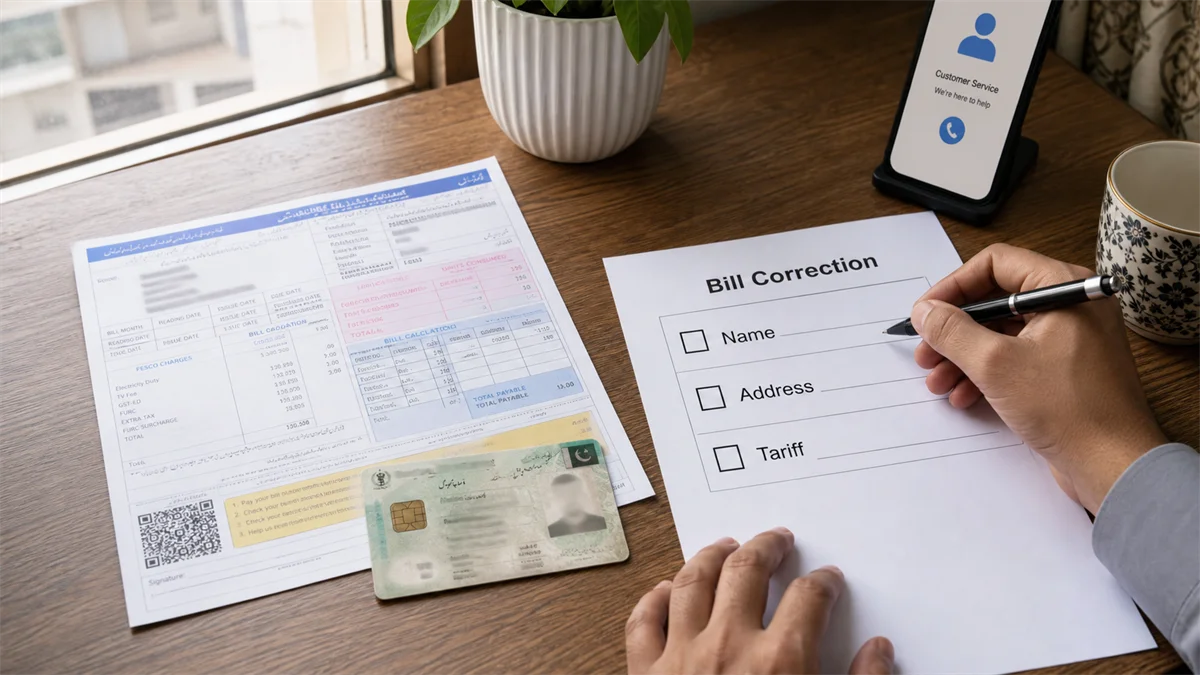
A wrong name or address on a GEPCO bill looks small until you need the bill for a bank file, tenancy proof, property sale, solar application, or new meter-related work. Then suddenly that spelling mistake becomes a proper headache. I have seen this happen in Gujranwala more than once: the electricity is working, the bill is being paid, but the consumer name still belongs to an old owner or a relative who shifted years ago.
This guide explains the practical route for correcting name, address, tariff category, load, and ownership details on a GEPCO bill. It is written for ordinary consumers, not office clerks. The exact requirement can vary by case, so use this as a preparation guide and confirm the final checklist with your concerned GEPCO subdivision or revenue office.
Quick Answer
To correct a GEPCO bill, first identify what is wrong: name, address, tariff, load, or ownership. Then take the latest bill, CNIC, property or tenancy proof, and a written application to the concerned GEPCO office. For tariff or load changes, GEPCO may inspect the premises and may ask for extra documents before updating the billing record.
First, Check What Actually Needs Correction
Do not walk into the office saying, "Bill theek karwana hai" and leave the rest to guesswork. Write down the exact issue. Is the consumer name misspelled? Is the old owner still showing? Is the house number wrong? Is a shop being billed as domestic, or a house being billed under the wrong tariff? Is the sanctioned load outdated after adding ACs or converting to three-phase?
Open your latest bill and check the reference number, customer ID, tariff, load, meter number, address, and consumer name. If you are unsure where these fields appear, read our guide on GEPCO reference number and customer ID first. Take a clear photo of the bill before visiting the office.
Name Correction vs Ownership Transfer
A spelling correction is not the same thing as ownership transfer. If the name is "Muhammad Imran" but the bill says "M Imran" or has a small spelling mistake, the office may treat it as a correction. If the connection is still in the name of a previous owner, deceased family member, builder, or landlord, it becomes a transfer or change-of-name matter and documents matter much more.
NEPRA's Consumer Service Manual includes provisions around change of name and consumer record changes for distribution companies. In plain language, the company must be satisfied that the applicant has a lawful basis for the change and that dues, security, and record requirements are handled properly. That is why ownership proof is usually the center of the file.
Common documents to keep ready
- Latest paid GEPCO electricity bill.
- CNIC copy of the applicant.
- Property ownership document, registry, allotment letter, transfer letter, or tenancy proof as applicable.
- Written application explaining the correction.
- Affidavit, undertaking, or no-objection document if GEPCO asks for it.
- Death certificate or legal-heir document where the previous consumer has died.
- Test report or load document if the correction involves load, phase, or tariff change.
Address Correction on a GEPCO Bill
Address corrections are often less dramatic than name transfer, but they still need care. A wrong street number, mohallah spelling, or house number can create confusion during meter replacement, complaint visits, new connection work, or property verification. If the meter is physically installed at the correct premises but the printed address is incomplete, explain it clearly in the application.
Take proof that connects the meter location with the address you want printed. That can be a property paper, tenancy agreement, tax record, society letter, or other official document, depending on your area. In older Gujranwala neighborhoods, addresses are not always written in one standard style, so keep your wording simple and consistent. Do not try to add a flashy address; use the address people can actually find.
Tariff Change: Domestic, Commercial, Industrial, or Other
Tariff correction is serious because it affects how the bill is calculated. A domestic connection is not meant for a proper shop, clinic, workshop, bakery, or small commercial setup. Likewise, a premises that has stopped commercial use should not keep carrying the wrong category if official conditions for correction are met.
NEPRA tariff terms and the Consumer Service Manual both treat consumer category and sanctioned load as important billing items. If GEPCO needs to change tariff, it may inspect the site, check actual use, review load, and ask for supporting documents. Do not assume the office will change tariff only because you wrote an application. The physical use of electricity must support the requested category.
A practical example: if someone opens a small shop in the front room of a house near GT Road, the family may still think of it as "ghar ka meter." GEPCO may not see it that way if electricity is being used for commercial activity. On the other side, if a shop has been closed and the place is now purely residential, you need documents and inspection to support the change back.
Load or Phase Correction
Load correction is linked with how much electricity your connection is sanctioned to use. If your bill shows a load that no longer matches your premises, or you have shifted from single-phase to three-phase needs, ask GEPCO what formal load extension or correction process applies. This is not just a spelling edit. It can affect security amount, fixed charges, wiring requirements, and future billing.
For homes adding multiple ACs, solar net metering, or heavier appliances, load details become more important. If you are planning solar or a green meter later, read our GEPCO net metering guide as well, because meter type, phase, and sanctioned load can become part of the discussion.
Step-by-Step Process
- Download or print the latest GEPCO duplicate bill and confirm the reference number.
- Write the exact correction you need: name, address, tariff, load, phase, or ownership.
- Prepare CNIC, bill copy, property/tenancy proof, and any supporting document.
- Visit the concerned GEPCO subdivision, revenue office, or customer service point.
- Submit the application and ask whether inspection, affidavit, test report, or dues clearance is required.
- Keep receiving copy, diary number, or any written proof of submission.
- Check the next bill carefully to confirm the correction appears in the billing record.
Do You Need to Clear Old Dues First?
In many change-of-name or ownership cases, dues status matters. GEPCO will not want a consumer record changed while arrears are sitting on the same connection. Before applying, check the latest bill for arrears, late payment surcharge, and payable amount. If there is a dispute, collect proof and resolve it through the complaint route rather than ignoring it.
If a seller tells you "bas naam badalwana hai, bill baad mein dekh lenge," be careful. For property purchases or transfers, clear electricity dues should be part of your checklist. The bill follows the premises, and confusion at this stage can become expensive later.
When the Correction Does Not Appear on the Next Bill
Sometimes the office accepts the file, but the next bill still shows old information. That does not always mean the application was rejected. It may have missed the billing cycle, stayed pending for approval, or required another document. Check again with your submission proof instead of starting from zero.
If there is no movement for a reasonable time, escalate politely with documents. Bring the latest bill, application copy, CNIC, and any receiving number. If the issue relates to wrong billing, tariff misuse, or unresolved complaint, our GEPCO complaint guide explains the complaint channels.
Final Advice
For a clean correction, keep the file boring and complete. One latest bill, one clear application, one CNIC copy, and one solid proof of ownership or use will take you further than repeated verbal visits. GEPCO staff will still follow their official process, but a neat file makes it harder for the matter to go in circles.
My own rule is simple: if the bill is going to be used for anything official, do not leave wrong details sitting there for months. Fix them before you need them urgently. It is much easier to correct a bill calmly on an ordinary weekday than to rush it when a bank, buyer, tenant, or solar installer is waiting.
References and source notes
1 NEPRA Consumer Service Manual, revised 2025: used for consumer record, connection, billing, load, tariff, and service-obligation context. View NEPRA PDF
2 GEPCO official website: used as the official distribution-company reference point for GEPCO consumers. View GEPCO website
3 GEPCO official duplicate bill page: used for consumer bill lookup and 14-digit reference-number context. View GEPCO bill page
Frequently Asked Questions
Can I correct a spelling mistake on my GEPCO bill?
Yes, but you should apply through the concerned GEPCO office with the latest bill, CNIC, and supporting proof. A spelling correction is usually simpler than ownership transfer.
Is tariff change allowed without inspection?
GEPCO may inspect the premises before changing tariff because the category must match actual electricity use. Commercial, domestic, industrial, and agricultural use are not billed the same way.
Will my correction show immediately?
Not always. It may appear in the next billing cycle after approval and system update. Keep your application receiving proof until the bill is corrected.