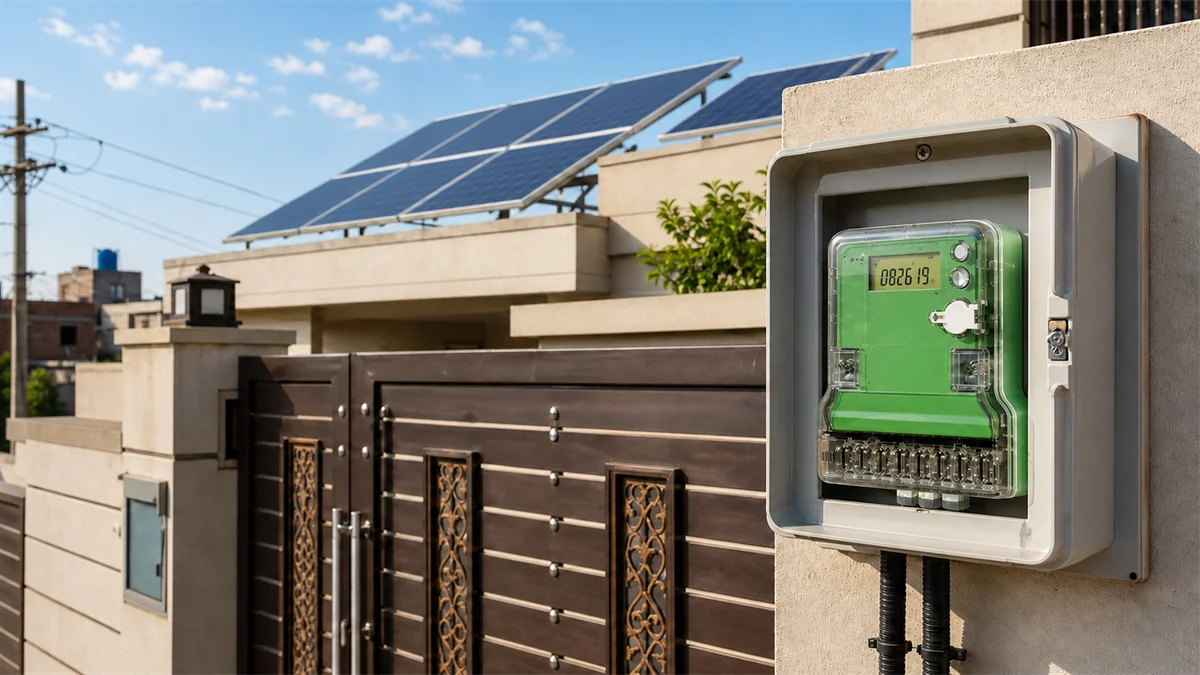
Solar has become a serious electricity-bill decision in Gujranwala, not just a showroom topic. In many streets of Model Town, Satellite Town, Wapda Town, Kamoke, Sialkot Road, and nearby areas, you can see panels on roofs that were empty a few summers ago. But the part people still mix up is the official GEPCO side: green meter, net metering, import/export units, approvals, and the new NEPRA prosumer rules.
This guide explains the process in plain language. I am keeping the wording practical because a solar quote from a vendor and an approved GEPCO prosumer connection are not the same thing. A vendor can install panels and an inverter, but the grid connection, meter, billing credit, and official permission depend on GEPCO, NEPRA rules, and your signed agreement.
Quick Answer
A GEPCO green meter is the common name for a bi-directional meter. It records the units you import from GEPCO and the solar units you export to the grid. Under NEPRA's 2026 Prosumer Regulations, new prosumer billing is based on imported electricity at the applicable tariff and exported electricity credited at the national average energy purchase price.1
Net Metering, Net Billing, and "Green Meter" Mean Different Things
Most people still say "net metering" for every solar connection where extra units go back to the grid. That is understandable because the term has been used for years. But in the current official language, NEPRA's 2026 framework uses the word prosumer: a consumer who also produces electricity from a distributed generation facility such as solar, wind, or biogas, up to 1 MW.1
The "green meter" is not a separate magic meter that makes electricity free. It is the consumer name for the import/export metering setup. The official point is that the meter must measure electricity flow in both directions. If you use GEPCO electricity at night, those units are imported. If your solar system produces extra power in the afternoon, those units can be exported and credited according to the applicable rules.
Who Can Apply for a GEPCO Solar Prosumer Connection?
NEPRA's interconnection agreement format says the applicant should be a 3-phase 400V or 11kV consumer and the distributed generation facility should be at least 1 kW and not more than 1 MW.1 The Ministry of Energy's official net metering page also says a three-phase connection and three-phase inverter are required for net metering, and that a bi-directional energy meter records import and export units.3
For a normal home, this means you should not buy equipment first and ask questions later. Before paying a large advance, confirm your sanctioned load, connection phase, inverter type, and current GEPCO requirements. If your house is still on single phase, ask GEPCO or a properly registered solar installer whether you need a phase conversion or load enhancement before the net metering file can move forward.
Hybrid Inverter vs Green Meter: Decide Your Goal First
A lot of confusion comes from treating "green meter" and "hybrid inverter" like two versions of the same thing. They are not. A green meter is mainly about official import/export billing with GEPCO. A hybrid inverter setup is mainly about using solar with batteries or backup circuits, especially when grid supply is off. The official Power Division FAQ says hybrid inverters are not allowed for net metering, so do not assume an export-plus-backup design will be accepted unless GEPCO confirms the exact equipment and wiring arrangement in writing.3
If your first priority is load shedding backup, do not assume a green meter alone will keep the house running when GEPCO supply is down. The U.S. Department of Energy explains that PV arrays can shut down when they sense loss of grid power for safety, while battery-backed systems can switch into an islanded mode and keep power on for selected loads.6 NEPRA's 2026 rules also require the interconnection facility, including the meter, to meet safety and protection requirements approved by the Authority.1
- If you only want bill reduction: an approved on-grid/prosumer setup may be enough, but check the current export-credit economics before calculating payback.
- If you want backup during load shedding: ask for a hybrid inverter, batteries, proper backup wiring, and clear isolation/protection for the loads you want to run.
- If you want export plus backup: be extra cautious. The official Power Division FAQ says hybrid inverters are not allowed for net metering, so confirm the exact inverter model, backup wiring, and GEPCO approval route before buying.
- If your meter is single phase: do not buy a large three-phase inverter until GEPCO or a qualified installer confirms phase conversion, sanctioned load, and green-meter eligibility.
A simple way to question any solar quotation is this: when GEPCO light goes off, exactly which fans, lights, fridge, or pump will stay on, for how many hours, and will this same design still qualify for green meter approval? If the seller cannot answer that clearly in writing, pause before paying.
The Usual GEPCO Green Meter Process
- Check your bill and load: confirm the reference number, tariff category, phase, sanctioned load, and billing history.
- Choose the right system size: do not size the solar system only by roof space. Compare it with your sanctioned load and real monthly consumption.
- Prepare technical documents: the application format asks for applicant details, premises location, technology, capacity, inverter information, installer information, and system drawings.
- Submit the case to GEPCO: the application goes to the distribution licensee for review, deficiency checking, interconnection assessment, and acceptance or rejection under the official process.
- Sign the agreement and complete testing: interconnection should happen only after required approvals, agreement, meter/testing formalities, and safety requirements are complete.
- Start checking import/export billing: after commissioning, read the GEPCO bill carefully to see imported units, exported units, credits, taxes, and any remaining payable amount.
If you travel often between Gujranwala, Lahore, and Islamabad, do not leave this whole process to a cousin or electrician with no paperwork trail. Ask for copies of the application, paid fee challans, inverter details, drawings, agreement, meter testing record, and any GEPCO acknowledgement. If a dispute comes later, your WhatsApp voice notes will not help as much as a proper document folder.
Documents and Details to Keep Ready
The NEPRA forms attached with the 2026 regulations show the kind of information expected in a prosumer file: applicant name, CNIC or company information, mailing address, phone number, email, location of generation system, expected annual consumption and production, inverter details, primary energy source, installer signature, and an application for concurrence.1 Your installer may prepare most of this, but you should still understand what is being submitted in your name.
For a household, keep your latest GEPCO bill, CNIC copy, ownership or occupancy proof if required, load details, solar system quotation, inverter datasheet, panel capacity, earthing/protection details, and clear contact information. For businesses, there may be additional company documents. If GEPCO points out a deficiency, fix it properly instead of pushing an incomplete file through informal channels.
How GEPCO Solar Billing Credits Work
The most important thing to understand is that imported and exported units are not necessarily treated as equal-value units under the 2026 prosumer framework. NEPRA's regulations say that electricity supplied by the licensee to the prosumer is billed according to the applicable tariff, while electricity supplied by the prosumer to the licensee is billed according to the national average energy purchase price.1
In simple language: the units you take from GEPCO are charged like normal consumption under your tariff. The extra solar electricity you send back earns a credit at the official export-credit rate. If your export credit is higher than the amount you owe for imported units, NEPRA's 2026 rules say the net billed amount can be credited to the next billing cycle or paid by the licensee quarterly, subject to the regulations and agreement.1
This is why payback calculations need care. A solar salesperson may show a very neat recovery table, but your actual result depends on daylight generation, your own daytime usage, inverter behavior, seasonal production, tariff category, export-credit rate, and whether fixed charges, taxes, FCA/FPA, or arrears apply. Our GEPCO unit prices and taxes guide explains the bill charges that can still appear even when solar reduces imported units.
Existing Net Metering Users Should Be Extra Careful
NEPRA notified the Prosumer Regulations 2026 on February 9, 2026, and its news page also lists an April 2, 2026 notification, S.R.O. 547(I)/2026, for amendments to those regulations.2 The original 2026 regulations repealed the older 2015 net metering regulations, but also included savings and transition wording for licences and agreements issued under the earlier framework.1
If you already have a GEPCO net metering agreement, do not assume every new social media post applies to your case. Check your agreement date, expiry, approved capacity, and whether you are planning any material modification. Increasing panels or changing inverter capacity without proper permission can create trouble. For an existing setup, confirm with GEPCO before changing system size, inverter, or interconnection equipment.
Common Mistakes Before Applying
- Buying an oversized system: a bigger system is not automatically better if your sanctioned load, transformer condition, or daytime consumption does not support it.
- Ignoring the inverter requirement: the official Power Division FAQ says a three-phase inverter is required for net metering.3
- Confusing gross savings with cash credit: reduced import units and export credits are separate parts of the bill.
- Not checking the bill after installation: compare import units, export units, payable amount, arrears, and credit balance every month.
- Trusting only vendor promises: always verify official requirements with GEPCO and NEPRA documents.
Where GEPCO Fits In
GEPCO serves Gujranwala and nearby districts including Sialkot, Gujrat, Hafizabad, Narowal, and Mandi Bahauddin according to its official profile.4 NEPRA also maintains a GEPCO-specific archive of distributed generation and net metering licences/concurrences, which shows that GEPCO-area solar cases are part of the national regulatory record.5
For a normal consumer, the practical route is still local: check your bill, talk to GEPCO or a credible installer, submit a complete file, and keep copies. If your bill later looks confusing, first compare it with your previous bills. Our guides on how to read a GEPCO bill, 2026 tariff updates, and GEPCO complaints can help you understand what changed.
Final Advice
GEPCO solar can make sense, especially for homes and businesses with strong daytime usage. But it should be treated like an electricity connection project, not just a panel purchase. Read your bill, size the system sensibly, use proper safety equipment, keep the application file clean, and understand the export-credit rule before calculating payback.
Before you apply, open your latest GEPCO duplicate bill and note the reference number, customer ID, tariff category, sanctioned load, and recent units. That one bill tells you more than a generic solar package poster. Once the green meter is live, keep checking each month until you are comfortable reading import, export, credit, and payable lines yourself.
References and source notes
1 NEPRA Prosumer Regulations 2026, notified on February 9, 2026: used for definitions, 1 kW to 1 MW agreement scope, 3-phase agreement wording, application details, metering requirements, safety/protection requirements, billing credits, quarterly payment/credit treatment, and savings/repeal provisions. View NEPRA PDF
2 NEPRA News page: used to verify that NEPRA listed S.R.O. 547(I)/2026 on April 2, 2026 as an amendment notification for the Prosumer Regulations 2026. View NEPRA news
3 Ministry of Energy, Power Division net metering page: used for practical consumer FAQ points on 3-phase requirement, bi-directional meter, inverter requirement, equipment, billing mechanism, and quarterly credit explanation. View Power Division page
4 GEPCO official website: used for GEPCO service-area context and official company profile. View GEPCO site
5 NEPRA GEPCO net metering/concurrence archive: used to verify that GEPCO-area distributed generation and net metering cases are published in NEPRA's official licensing record. View NEPRA GEPCO archive
6 U.S. Department of Energy solar resilience basics: used only for general inverter/backup behavior, including PV shutdown on loss of grid power and battery-backed islanded operation. View DOE page
Frequently Asked Questions
Is a green meter the same as net metering?
Not exactly. Green meter is the common name for the bi-directional meter. Net metering or prosumer billing is the official arrangement that decides how import and export units are billed and credited.
Can GEPCO pay me if my solar export is higher than import?
NEPRA's 2026 rules say excess net billed amount can be credited to the next billing cycle or paid quarterly by the licensee, subject to the regulations, billing data, and your agreement.
Will my solar work during load shedding if I have a green meter?
A green meter alone does not provide backup. Backup depends on inverter type, batteries, approved isolation/protection, and backup wiring. If load shedding backup matters, ask for a proper hybrid or battery-backed design before applying.
Should I install solar before GEPCO approval?
Do not connect a solar system to the grid informally. Prepare the file, follow GEPCO and NEPRA requirements, complete testing and agreement steps, and keep all approvals before relying on export credits.