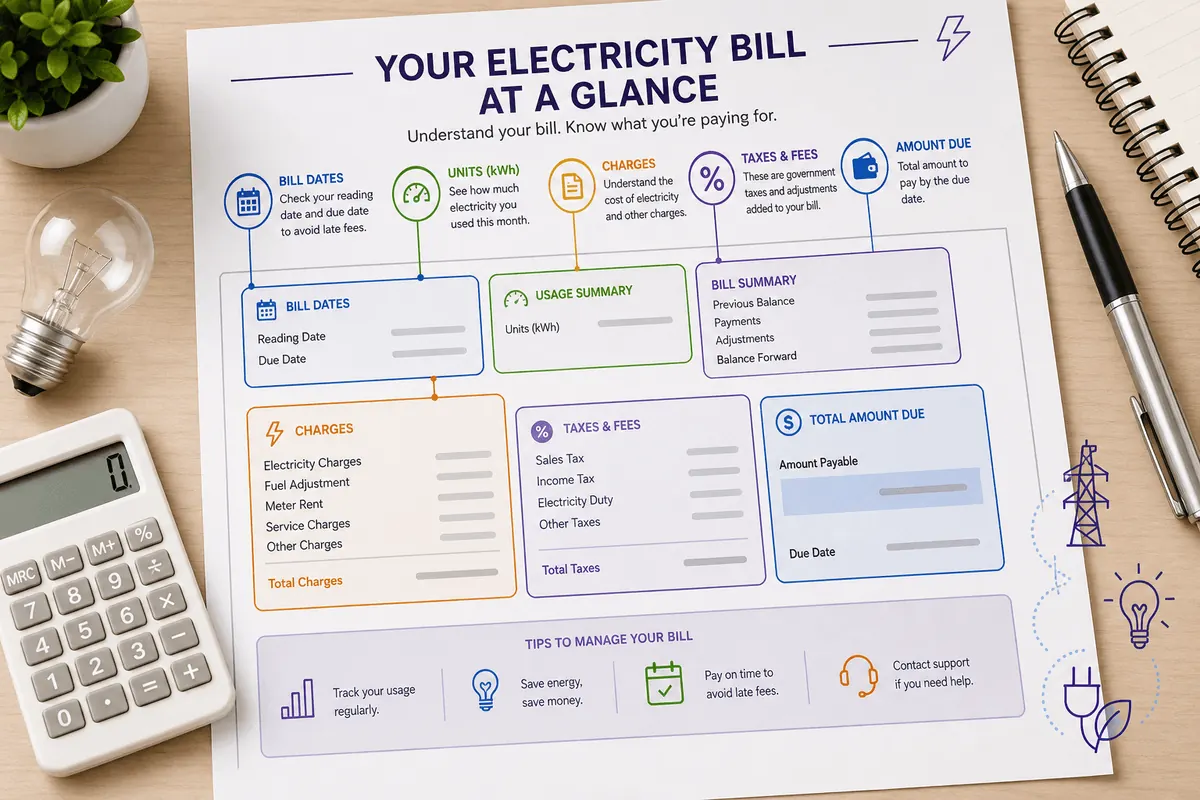
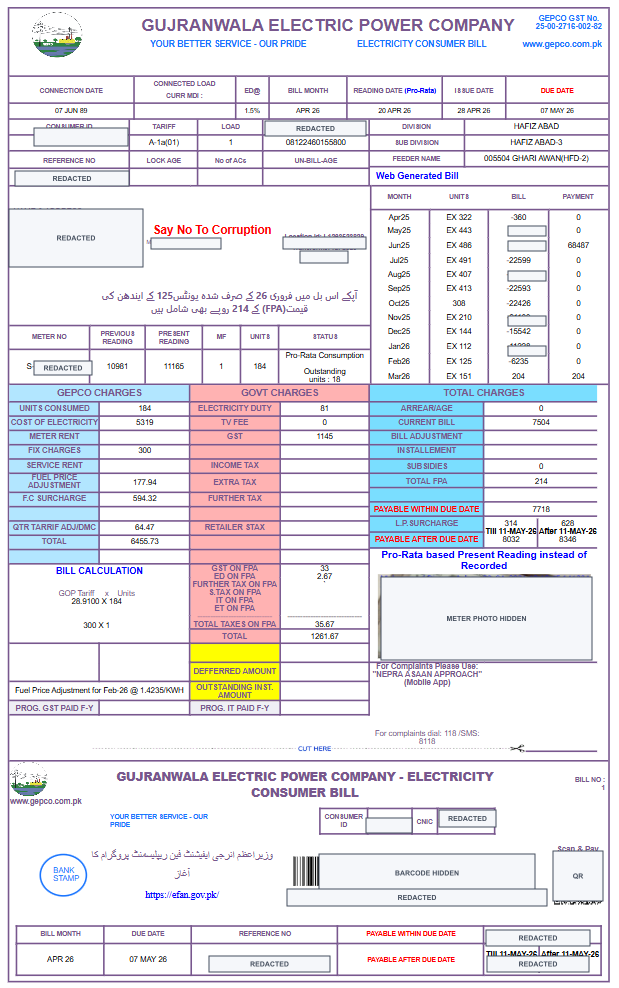
A GEPCO bill looks simple until you actually try to understand it. One side shows the units, another side shows GEPCO charges, then government charges, then total charges, arrears, FPA, late surcharge, and a billing history table. If you are just trying to pay before the due date, it can feel like too much information on one page.
The easiest way is to read the bill in sections. First confirm the bill month and due date. Then check units consumed. After that, look at current bill, arrears, taxes, and the final payable amount. Once you understand this flow, the bill stops looking like a wall of numbers.
Quick Reading Order
Start with Bill Month, Due Date, Units Consumed, Current Bill, Arrear/Age, and then the final Payable Within Due Date amount.
1. Bill Month, Reading Date, Issue Date, and Due Date
The top area of the bill tells you which month the bill belongs to and when the meter reading was taken. The Bill Month is the billing cycle, not always the exact month you are paying in. The Reading Date tells when the meter reading was recorded, while the Issue Date is when the bill was generated.
The most important date for payment is the Due Date. If you pay after that date, the bill may include a late payment surcharge. If you are checking the bill online close to the due date, first verify the current amount through the GEPCO bill checker or the official PITC portal.
2. Reference Number and Customer ID
The reference number and customer ID are bill identifiers. You need these when checking a duplicate bill or paying through a bank or mobile wallet. The 14-digit reference number is the most commonly used number for duplicate bill lookup.
If you are not sure which number is which, read our visual guide on how to find your GEPCO reference number and customer ID.
3. Units Consumed and Meter Reading
The units section compares the previous reading with the present reading. In simple words, GEPCO subtracts the previous meter reading from the present meter reading to calculate your units consumed for that billing cycle.
If the bill says Pro-Rata Consumption, it usually means the bill is based on a partial-period reading or adjusted reading cycle. This is not automatically an error, but if the units look unusual, compare the printed reading with your actual meter and contact GEPCO if something looks clearly wrong.
4. Tariff Category, Protected Status, and Sanctioned Load
Before you judge the amount, check the tariff category and status printed on the bill. A domestic protected consumer, an unprotected domestic consumer, a TOU three-phase consumer, and a small commercial shop are not billed the same way. If the protected/unprotected label is confusing, read our GEPCO protected vs unprotected consumer guide.
- Protected or lifeline: lower-rate categories for eligible low-consumption users.
- Unprotected: normal residential billing where higher unit bands can increase the base rate.
- Sanctioned load: the approved load for your connection. Higher-load and TOU connections can have different fixed charges.
- Tariff category: tells whether the connection is domestic, commercial, industrial, agricultural, or another notified category.
5. GEPCO Charges
The GEPCO Charges section includes the electricity cost and related distribution charges. The biggest line is usually Cost of Electricity, which depends on your units, tariff category, and official tariff rates.
You may also see fixed charges, meter rent, fuel price adjustment, finance cost surcharge, quarterly tariff adjustment, or similar billing lines. These can change based on category and official notifications, so use the bill itself as the final source for that month. For a deeper tariff explanation, read our GEPCO unit prices and taxes guide.
6. Government Charges: GST, Electricity Duty, TV Fee, and Taxes
This is the part people usually dislike, because the bill amount can jump even when the unit count does not look too high. Government charges can include GST, Electricity Duty, TV Fee, and other taxes or surcharges depending on the notification period and consumer category.
GST is a federal tax. Electricity Duty is a government duty shown separately. TV Fee is a fixed levy that appears on many domestic bills. If a tax or charge looks unfamiliar, compare it with the printed bill and official tariff information rather than relying on forwarded screenshots or old rate tables.
7. FPA: Fuel Price Adjustment
FPA means Fuel Price Adjustment. It reflects fuel-cost changes in electricity generation and is handled through official power-sector processes. Sometimes it increases the bill. In some periods, an adjustment can reduce or offset a portion of the amount.
The key point: FPA is not your meter reader adding something by hand. It is a formal adjustment line, and it may relate to an earlier consumption period. For final current notifications, verify through official NEPRA and GEPCO information.
8. Current Bill, Arrear/Age, and Total Payable
The Current Bill is the amount for the current billing cycle before carried-forward balances and final adjustments. The Arrear/Age line shows an old balance, credit, or adjustment from a previous month. If the arrear is positive, it can increase your bill. If it is negative, it may reduce the amount payable.
Finally, check the Payable Within Due Date and Payable After Due Date amounts. The after-due-date amount is higher because it includes late payment surcharge. When paying through JazzCash, EasyPaisa, or a bank app, always compare the fetched amount with the latest duplicate bill. Our GEPCO online payment guide explains that step.
9. Billing History Table
The billing history table shows previous months, units consumed, bill amounts, and payment status. This is useful when you want to know whether your usage suddenly increased or whether a previous payment was adjusted later.
If your current bill feels high, do not look only at the current month. Compare three to six months of units. If units are similar but the amount is much higher, the reason may be tariff slab, protected/unprotected status, FPA, taxes, arrears, or a delayed adjustment.
What to Check Before Paying
- Confirm the bill month is the current month you want to pay.
- Check the due date and payable-within-due-date amount.
- Compare units consumed with the previous month.
- Check whether any arrears, FPA, or adjustments were added.
- Make sure the reference number/customer ID matches your connection.
- If paying online, confirm the biller name and amount before entering your PIN.
Official sources: This guide is based on the layout of a redacted GEPCO consumer bill, GEPCO duplicate bill instructions, PITC bill lookup flow, and NEPRA tariff/regulatory information. For official bill lookup, verify through the GEPCO duplicate bill page or the official PITC billing portal. For tariff and regulatory notices, check NEPRA.
Frequently Asked Questions
What is the most important number on a GEPCO bill?
For duplicate bill checking, the most important number is usually the 14-digit reference number. For payment, also check the bill month, due date, and payable amount.
Why is payable after due date higher?
It includes a late payment surcharge. The exact surcharge and cutoff dates are printed on the bill, so pay before the due date whenever possible.
What does arrear mean on a GEPCO bill?
Arrear usually means an amount carried forward from a previous month. A negative arrear can mean a credit or adjustment that reduces the current payable amount.
How do I know if my GEPCO bill is unusually high?
Compare current units with previous months in the billing history table. If units are similar but the amount is much higher, check tariff slab, FPA, taxes, arrears, and adjustments.