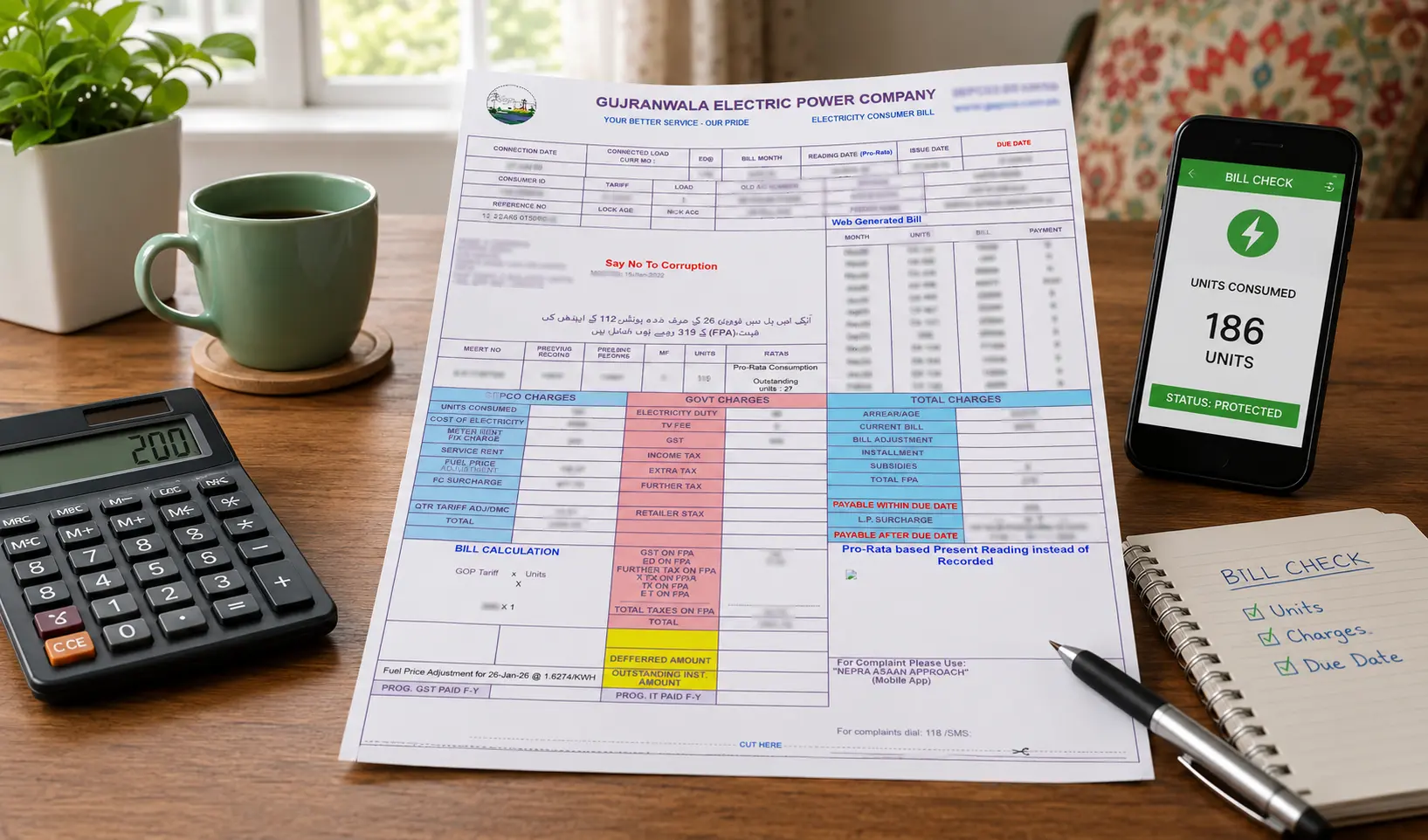
If your GEPCO bill suddenly jumps even though your home usage looks almost the same, one of the first things to check is whether you are being billed as a protected or unprotected consumer. This one label can change the per-unit rate, the fixed charges, and the way your monthly bill feels.
In Gujranwala, this confusion comes up every summer. A family runs the AC a little more in June, crosses 200 units, and then wonders why the next bill feels like it belongs to a different house. The same happens when someone is travelling between Gujranwala, Lahore, and Islamabad and only sees the bill photo on WhatsApp. You see the payable amount first, but the real story is often hidden in the tariff category and units history.
Quick Answer
A protected consumer is a low-consumption residential user who qualifies for lower protected/lifeline rates. An unprotected consumer is billed under higher residential slabs. The practical line most people worry about is 200 units, because crossing it can push a household into the unprotected category under the current billing practice.3
What Does Protected Consumer Mean?
A protected consumer is a residential electricity user who falls under subsidized low-consumption categories. NEPRA's 2026 consumer-end tariff schedule lists separate residential rates for lifeline and protected users, including lifeline slabs up to 50 units and 51-100 units, plus protected residential slabs for 1-100 and 101-200 units.1
In simple words: protected status is meant for households that use very little electricity. These are usually smaller homes, rooms, or careful families that keep fans, lights, and basic appliances under control. The rates are lower because the government keeps this category softer for low-usage domestic consumers.
What Does Unprotected Consumer Mean?
An unprotected consumer is still a normal residential consumer, but not in the protected low-usage category. Once the bill is treated as unprotected, the higher residential slabs apply. In NEPRA's 2026 schedule, unprotected residential rates start from Rs. 22.44 per unit for 1-100 units and rise through higher bands up to Rs. 47.20 per unit above 700 units.1
This is why people say, "200 units se upar bill bohat barh jata hai." It is not only the extra units. It is the category and slab structure that can make the bill feel heavier.
Protected vs Unprotected Rates in 2026
- Lifeline up to 50 units: Rs. 3.95 per unit.
- Lifeline 51-100 units: Rs. 7.74 per unit.
- Protected 1-100 units: Rs. 10.54 per unit.
- Protected 101-200 units: Rs. 13.01 per unit.
- Unprotected 1-100 units: Rs. 22.44 per unit.
- Unprotected 101-200 units: Rs. 28.91 per unit.
- Unprotected 201-300 units: Rs. 33.10 per unit.
- Unprotected 301-400 units: Rs. 36.46 per unit.
- Unprotected 401-500 units: Rs. 38.95 per unit.
- Unprotected 501-600 units: Rs. 40.22 per unit.
- Unprotected 601-700 units: Rs. 41.85 per unit.
- Unprotected above 700 units: Rs. 47.20 per unit.
These are base tariff figures. Your final GEPCO payable amount can still include GST, electricity duty, FCA/FPA, quarterly tariff adjustment, arrears, TV fee, and fixed charges where applicable. For those details, read our GEPCO unit prices and taxes guide.
The 200-Unit Rule: Why One Month Matters
The protected category is explained in official NEPRA policy material around residential Non-TOU consumers with consumption of 200 units or less in the last six months.3 In practical consumer terms, crossing 200 units can affect status for a following period, while returning to protected status depends on recorded billing history and official rules. Because this is a billing-status issue, always confirm your own status from the latest GEPCO/PITC bill and the concerned subdivision if the category looks wrong.
That is why 201 units feels so painful. The difference between 199 and 201 units is not just two units. It can change the category applied to the bill. If your house normally stays around 170-190 units, watch the last few days of the billing month carefully. Running the iron, water motor, microwave, or AC carelessly near the end can push you over.
Where to Check Your Status on the Bill
Open your latest duplicate bill and look near the tariff/category area. You may see labels or category wording related to residential, protected, unprotected, lifeline, or TOU. The exact layout can vary between printed and online bill copies, so also compare your units history table at the bottom of the bill.
If you do not have the latest bill, enter your 14-digit reference number or customer ID on the GEPCO bill checker. Once the PITC bill opens, check the units and category before paying.
Fixed Charges Can Also Affect the Bill
In 2026, fixed charges became an important part of residential billing discussions. NEPRA's February 2026 tariff rationalization schedule lists fixed charges for protected, unprotected, and TOU residential categories, with amounts depending on the notified category, consumption band, sanctioned load, or MDI rule.1 NEPRA's GEPCO tariff page is the safer place to check later tariff entries before relying on any copied rate table.2
The safe takeaway is this: do not judge your bill only by units multiplied by unit rate. Check the fixed charge line, adjustment lines, and arrears. If your units are low but your bill still looks high, fixed charges or past adjustments may be part of the answer.
How to Avoid Losing Protected Status
- Check your meter every few days if you are close to 200 units.
- Avoid using AC, iron, water motor, and microwave together near month-end.
- Shift heavy work to cooler hours where possible, especially in summer.
- Replace old bulbs with LED lights and avoid leaving fans running in empty rooms.
- Compare the last six months in your bill history table, not only the current month.
- If your status looks wrong, visit or contact the GEPCO subdivision office with recent bills and meter photos.
When Should You Contact GEPCO?
Contact GEPCO if your bill category looks wrong, your units history does not match your actual usage, your meter was replaced recently, or you believe your protected status was lost due to a reading or record issue. Keep copies of recent bills, a clear meter photo, and your reference number. For complaint options, see our GEPCO complaint guide, our bill not found troubleshooting guide, or the GEPCO contact page.
Final Advice for GEPCO Users
If your home is around the 180-220 unit range, protected vs unprotected status matters a lot. A small change in usage can have a bigger effect than you expect. Before the due date, open your latest bill, check the category, check the unit history, and then pay through your bank app, JazzCash, EasyPaisa, or another official payment channel. Our online payment guide explains that step.
References and source notes
1 NEPRA February 2026 tariff rationalization decision: used for lifeline, protected, unprotected, TOU, fixed-charge, and residential tariff-rate figures. View NEPRA PDF
2 NEPRA GEPCO tariff page: used to verify 2026 GEPCO tariff notifications, including January and February 2026 tariff entries. View NEPRA GEPCO tariff page
3 NEPRA determination on power-sector subsidy retargeting: used for the official 200-unit / last-six-months protected-category explanation. View NEPRA PDF
Frequently Asked Questions
Is protected status permanent?
No. It depends on usage history and official billing rules. If your usage crosses the protected threshold, your bill may move to the unprotected category.
Can I check protected status with CNIC?
No. For normal online bill checking, use the reference number or customer ID printed on your GEPCO bill. CNIC is not the usual duplicate-bill lookup field.
Why did my bill rise after using slightly more units?
Your category may have changed, or a higher slab, fixed charge, FCA/FPA, QTA, arrears, or tax adjustment may have applied. Always compare units, category, and adjustment lines together.