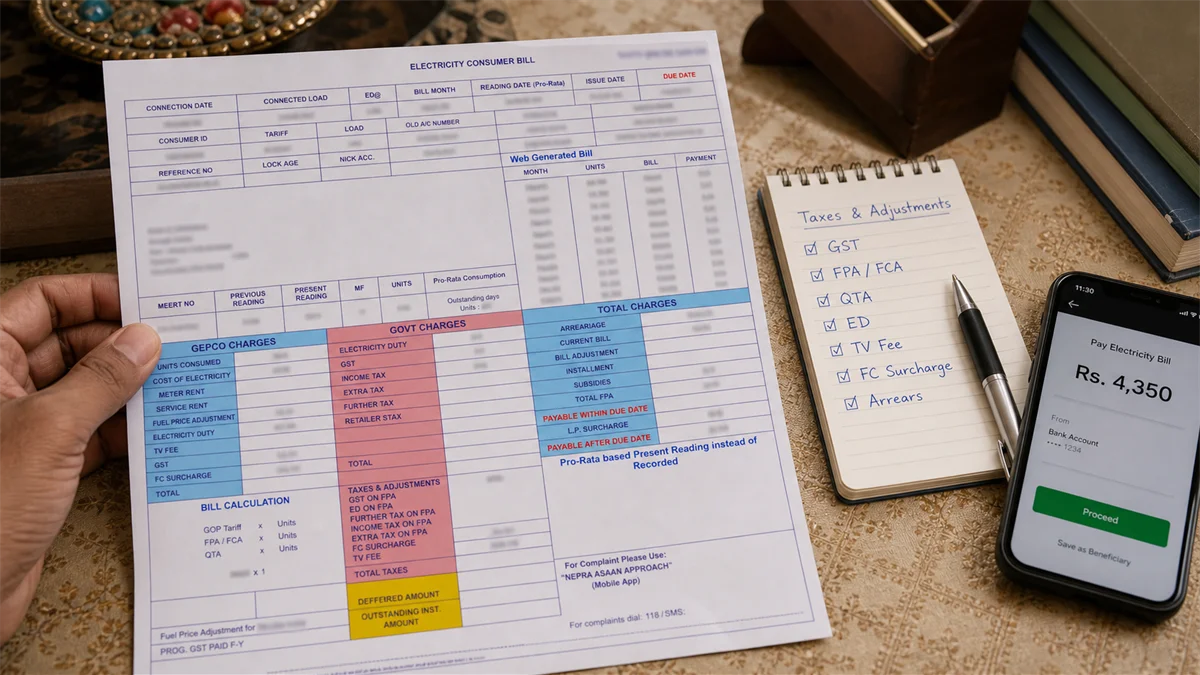
A GEPCO bill rarely becomes painful because of one line only. The unit cost matters, of course, but the real surprise usually comes from the smaller rows: GST, FPA or FCA, QTA, electricity duty, TV fee, FC surcharge, arrears, and late payment surcharge. I have seen this myself in Gujranwala, especially in summer, when the family thinks the bill is only about AC units and then the government-charge section quietly adds another chunk.
This guide is only about those tax and adjustment lines. For basic unit slabs, see our GEPCO unit price guide. Here we will focus on what each tax or adjustment means, why it appears, and what you should check before assuming the bill is wrong.
Quick Answer
GST, electricity duty, TV fee, and surcharges are government or tariff-related charges. FPA/FCA and QTA are adjustment items linked to power purchase cost and tariff decisions. GEPCO collects these through the bill, but most of these amounts are based on official NEPRA/government notifications, not a local office decision.
GST: The Most Visible Government Tax
GST means General Sales Tax. On electricity bills, it is usually one of the largest tax lines because it is calculated on eligible electricity charges and adjustments according to official tax rules. If your units rise, GST usually rises too because the taxable base has become larger.
A common mistake is comparing only units with a neighbor. Two houses may use similar units, but a different tariff category, arrears, fixed charge, or adjustment can make the GST line look different. Before complaining, compare the full bill: connection category, units, arrears, fuel adjustment, and taxes.
FPA/FCA: Fuel Price Adjustment
Fuel Price Adjustment, also called Fuel Charges Adjustment in many discussions, is the line most consumers notice after a sudden jump. It reflects the difference between assumed fuel/power purchase cost and actual cost for a relevant period. NEPRA issues monthly fuel-cost decisions and DISCOs recover or credit the approved amount through bills.
The confusing part is timing. FPA on your May bill may not feel like May usage. It can relate to an earlier billing month, so a low-current-usage month can still show a noticeable fuel adjustment. That is why I tell people not to judge FPA by memory. Open the bill, read the adjustment month if shown, and check official NEPRA/GEPCO information for the period.
QTA: Quarterly Tariff Adjustment
QTA means Quarterly Tariff Adjustment. It is separate from monthly fuel adjustment. A simple way to think about it: FPA/FCA is linked to monthly fuel or power purchase cost variation, while QTA is linked to quarterly tariff adjustment decisions for distribution companies.
QTA can feel unfair because it appears later and is not always connected to what the household did this week. But on the bill, it is part of the officially notified tariff mechanism. If the QTA line is large, compare it with your billing period, category, and units. If the amount looks obviously abnormal, keep the bill copy and file a complaint instead of waiting for the next month.
FPA vs QTA in simple words
- FPA/FCA: usually monthly fuel or power purchase cost adjustment.
- QTA: quarterly tariff adjustment notified through official tariff decisions.
- Both can be positive or negative: depending on the official decision for that period.
- Both can appear with delay: so they may not match the month you mentally associate with the bill.
Electricity Duty and TV Fee
Electricity Duty, often written as ED, is a provincial/government levy collected through the electricity bill. It is not the same as GST. The amount depends on the applicable rules and category. If your tariff category is wrong, ED can also look wrong, which is why category correction matters.
The TV fee is a small fixed government charge that many domestic consumers see on their bills. It is usually much smaller than GST or fuel adjustment, but people notice it because it appears even when they do not actively think of it as an electricity cost. GEPCO does not treat this like a voluntary service charge; it is billed according to government instructions.
FC Surcharge, Meter Rent, and Service Charges
FC surcharge is generally understood as a financing-cost surcharge related to power-sector financing/circular-debt recovery. Meter rent or service-rent style lines depend on category and applicable billing rules. These are usually smaller than the electricity cost, but they can still make the total feel messy when multiple small lines stack together.
If you are checking a shop, small factory, tube well, or three-phase connection, do not assume the domestic bill explanation applies exactly. Commercial, industrial, agricultural, and TOU categories can carry different fixed charges and tariff treatment.
Arrears and Late Payment Surcharge
Arrears are previous unpaid amounts or balance carried forward. Sometimes the current bill is not the real problem; the arrear line is. If you paid last month, compare your receipt or banking transaction with the bill history. A payment posting delay or wrong reference number can create stress later.
Late Payment Surcharge is different from tax. It is added when payment is made after the due date under the applicable rules. We have a separate detailed guide on GEPCO due date, LPS, and disconnection rules.
How to Check Whether a Tax Line Is Wrong
First, open the latest bill and check the reference number, consumer category, units, billing month, and previous balance. Then compare the tax/adjustment section with the total charges section. If only one tax line looks high, the cause may be an adjustment. If many lines look high, the base bill, arrears, or category may be the real reason.
If you are travelling and checking from Lahore or Islamabad, download the duplicate bill online and save a screenshot before calling home. It is easier to discuss exact line items than to argue from memory. If something looks wrong, take a meter photo, bill copy, and payment proof to the complaint channel. Our GEPCO complaint guide explains the routes.
Final Advice
Taxes and adjustments are frustrating, but they are easier to understand when you separate them from unit price. Unit rate tells you the energy cost. GST and ED are tax lines. FPA/FCA and QTA are official adjustment lines. Arrears and LPS are payment-history lines. Once you group them this way, the bill becomes less mysterious and your complaint becomes more specific.
References and source notes
1 NEPRA GEPCO tariff page: used for GEPCO tariff notification context, FPA/FCA, quarterly tariff adjustment, and surcharge/tariff references. View NEPRA GEPCO tariff page
2 NEPRA Consumer Service Manual, revised 2025: used for electricity bill field terminology, bill descriptions, and payment/billing context. View NEPRA PDF
3 GEPCO official duplicate bill page and PITC portal: used for official duplicate bill verification route. View GEPCO page
Frequently Asked Questions
Is FPA or FCA the same as GST?
No. GST is a tax. FPA/FCA is a fuel or power purchase cost adjustment approved through official tariff mechanisms.
Why did my bill increase when my units were similar?
Check FPA/FCA, QTA, arrears, fixed charges, and LPS. The unit count can be similar while adjustment or arrear lines change the final payable amount.
Can I refuse to pay TV fee or GST?
A consumer can challenge wrong billing or wrong category, but ordinary government taxes and levies are billed according to official instructions and are not removed by simple request.