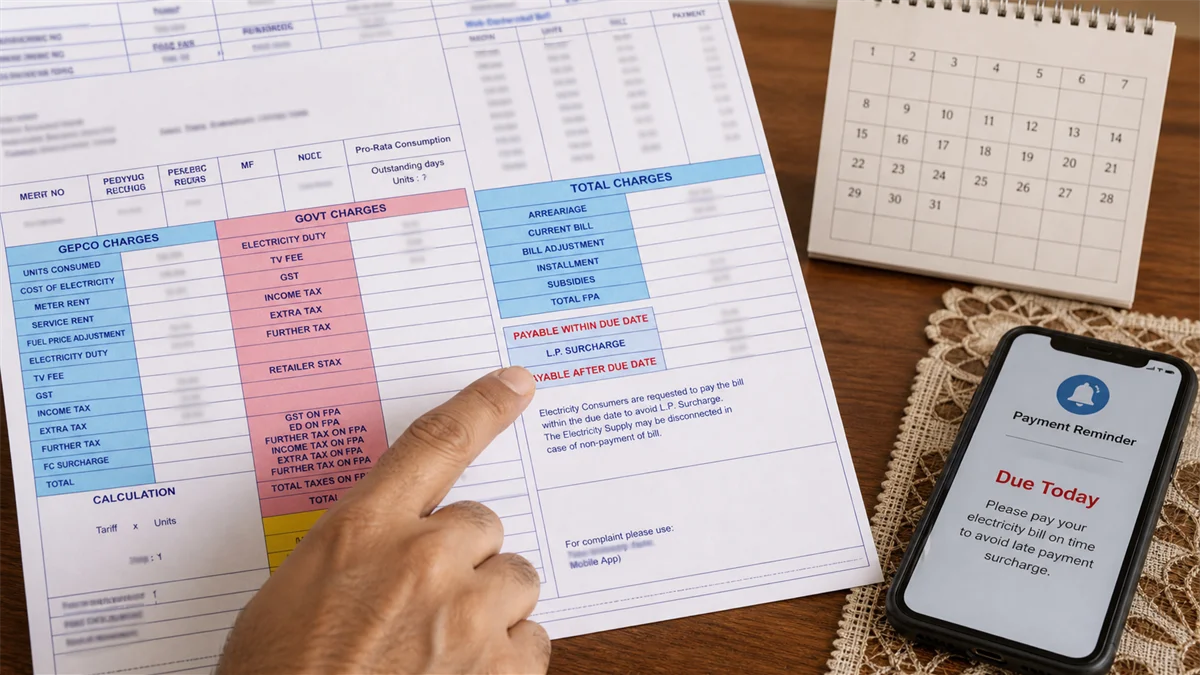
The due date on a GEPCO bill looks like a small line, but it decides three practical things: how much you pay, whether late payment surcharge is added, and whether an old unpaid bill can become a disconnection issue. In Gujranwala, this becomes especially stressful when the bill arrives late, someone at home forgets to send the picture, or you are travelling between Lahore and Islamabad and only see the amount on the last day.
This guide explains the official process in plain language: how the due date is shown, what late payment surcharge means, when an extension or installment can help, and when GEPCO can move toward disconnection for non-payment. The rule details below are based on NEPRA's Consumer Service Manual and GEPCO's official bill/consumer pages, not on forwarded messages.
Quick Answer
Pay your GEPCO bill by the due date printed on the bill. If you pay after due date, Late Payment Surcharge can be added. NEPRA's manual says a connection should not be disconnected just for missing the current month bill if there are no previous outstanding dues, but non-payment of the previous month bill can lead to a clear seven-day notice along with the next bill.1
Where to Check the GEPCO Due Date
Open the latest duplicate bill and look for Due Date, Amount Payable within Due Date, and Amount Payable after Due Date. These lines matter more than the bill month alone. The bill month tells the cycle; the due date tells the last normal payment date.
If you do not have the paper bill, use the GEPCO bill checker with your reference number or customer ID, or verify from GEPCO's official duplicate bill page. GEPCO's page asks for the 14-digit numeric reference number and notes that all branches of all commercial banks are authorized to collect electricity bills.2
How Much Time Should a Consumer Get?
NEPRA's Consumer Service Manual says DISCOs should render bills for payment by the due date and that the due date should generally be within fifteen days from the issue date of the bill. It also says bills are required to be delivered at least seven days before the due date, and if a bill is not served at least seven days before the due date, late payment surcharge is to be levied after the seventh day from delivery of the bill.1
In real life, many people only notice the bill when the due date is close. If the paper bill is late or missing, do not wait for the meter reader or distributor. Check the duplicate bill online. I do this myself when I am away from Gujranwala, because one missed due date can quietly turn a normal bill into a higher payable amount.
What Is Late Payment Surcharge?
Late Payment Surcharge, usually written as LPS, is the amount charged when the bill is not paid within the due date. NEPRA's bill-description table defines LPS as the amount levied on account of non-payment of bill within due date, and defines the payable-after-due-date amount as the total payable within due date plus late payment surcharge.1
Current tariff terms notified through NEPRA's GEPCO tariff page include the updated LPS structure: 5% may be levied for the next three days after the due date, and thereafter 10% LPS may be charged on the amount billed excluding government taxes and duties.4 Always rely on the exact amount shown on your latest bill, because the bill already calculates the payable dates and amounts for that billing cycle.
- Within due date: pay the normal amount printed as payable within due date.
- After due date: pay the amount shown for the relevant late-payment period.
- Online payment: refresh the biller amount in your bank app before paying.
- Wrong bill dispute: keep paying current undisputed bills while pursuing the complaint route.
Can You Request Due Date Extension?
Yes, but it is not automatic. NEPRA's manual includes a due date extension and installment section. It says LPS will not be imposed where the due date is extended, and the DISCO shall generate computerized bills after allowing installments or due date extension.1
The safest practical approach is to contact the concerned GEPCO subdivision or revenue office before the due date, especially if the amount is large or the bill appears late. Do not assume a verbal promise is enough. Ask what document, application, or computerized revised bill is needed. For complaint routes and contact options, see our GEPCO complaint guide.
Installments: Helpful, But Read the Conditions
If the current month's bill is difficult to pay in one go, installments may be allowed by GEPCO according to the official process. NEPRA's manual says that if an installment request for the current month bill is made, there is no markup or LPS if the first installment is paid within the due date. Remaining installments are paid with markup on a pro-rata basis under the manual's installment rules.1
Installments are not the same as ignoring the bill. If installments are approved, keep paying them on time. The disconnection section says supply of consumers allowed to pay in installments shall not be disconnected while installments are being paid, but if the consumer defaults on installments, supply may be disconnected without further notice and restored only after receipt of minimum required dues.1
Can GEPCO Disconnect After One Missed Bill?
This is the point many consumers misunderstand. NEPRA's Consumer Service Manual says the consumer is bound to pay the electricity bill within due date, or with late payment surcharge if paid after due date. But it also says the connection shall not be disconnected if a consumer fails to deposit the current month bill, provided there are no outstanding dues. It further states that no connection shall be disconnected on default of one month bill.1
That does not mean you should casually delay payment. It means the formal disconnection process is tied to outstanding dues and notice. If a previous month remains unpaid, the manual says the DISCO should issue a clear seven-day notice along with the second month bill, asking the consumer to clear outstanding dues with the second month bill or face disconnection. The notice may be printed or stamped on the electricity bill.1
What Happens If the Second Month Also Goes Unpaid?
If payment is still not received and the due date on the second month bill expires, the manual says the supply of the defaulting premises shall be disconnected. In that situation, supply should not be restored until full payment with late payment surcharge is made, or payment in approved installments is made, depending on what GEPCO allows in the case.1
If the consumer fails to pay the third month bill along with arrears of the previous two months within the due date, the manual allows issuance of an Equipment Removal Order and removal of metering installation/material, with permanent disconnection code. Restoration then requires payment of outstanding dues and completion of other reconnection formalities.1
Wrong Bill or Dispute: What Should You Do?
If the bill looks wrong, do not simply ignore it. Compare the reference number, meter reading, units, arrears, due date, and surcharge lines. Our GEPCO bill reading guide explains the layout, and our unit prices and taxes guide explains why a bill can rise even when usage looks normal.
NEPRA's manual also protects consumers in a specific dispute situation: power supply of a defaulting consumer shall not be disconnected where a complaint or petition about wrong billing or payment dispute is lodged with NEPRA and restraining orders have been issued. However, the consumer must continue to pay current bills regularly.1
Practical Checklist Before the Due Date
- Open the latest duplicate bill and confirm bill month, reference number, and due date.
- Compare payable within due date and payable after due date.
- If paying through mobile banking, refresh the bill before entering your PIN.
- If you need extension or installment, contact GEPCO before the due date.
- If the bill is wrong, file a complaint with proof instead of waiting silently.
- If there are arrears, treat the matter as urgent because older dues can trigger notice and disconnection steps.
Final Advice
For most households, the best habit is simple: check the GEPCO bill online as soon as the bill month starts showing, save the PDF or screenshot, and pay before the due date. If you are away from home, ask someone to send the bill photo, but still verify it online. A clear bill record is useful if a payment status, arrear, or surcharge dispute comes up later.
If you are already behind by one month, do not wait for a lineman to come to the gate. Visit the concerned office, ask about payment, installment, or extension options, and keep receipts. The earlier you act, the easier it is to avoid surcharge stress, disconnection notice, and reconnection formalities.
References and source notes
1 NEPRA Consumer Service Manual, revised 2025: used for due date, bill delivery, bill particulars, LPS definition, payment collection, due date extension/installments, disconnection notice, non-payment disconnection, installment default, wrong-billing dispute, and reconnection rules. View NEPRA PDF
2 GEPCO official duplicate bill page: used for 14-digit reference number guidance and official bill collection note. View GEPCO page
3 PITC official GEPCO bill portal: used as the official bill lookup destination for duplicate bill verification. View PITC portal
4 NEPRA GEPCO tariff page and S.R.O. 1160(I)/2025 listing: used for current GEPCO tariff notification context, including updated late payment surcharge tariff terms. View NEPRA GEPCO tariff page
Frequently Asked Questions
Can GEPCO disconnect electricity after one unpaid current bill?
NEPRA's manual says no connection shall be disconnected on default of one month bill, and a current-month non-payment should not cause disconnection if there are no outstanding dues.
What is LPS on a GEPCO bill?
LPS means Late Payment Surcharge. It is added when the bill is not paid within the due date and appears in the payable-after-due-date amount.
Can I get a GEPCO bill due date extension?
Due date extension may be allowed through the official GEPCO/DISCO process. Request it before the due date and ask for the computerized revised bill or official record.
What should I do if the bill is wrong but the due date is close?
File a complaint with meter photo, bill copy, and reference number. Do not ignore future current bills; NEPRA's dispute protection still requires current bills to be paid regularly where applicable.